

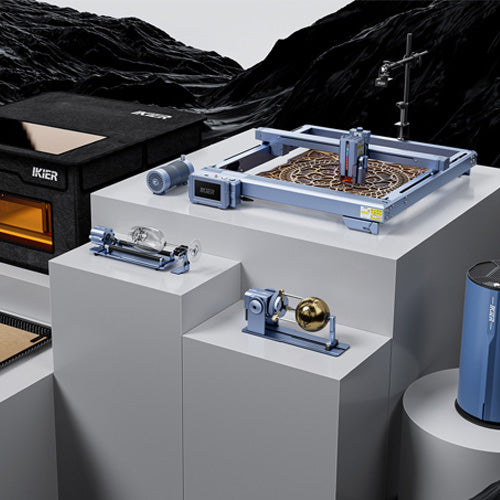
Überblick über den Laserschnitt
Der Laser ist der vielseitigste, vielseitigste, schönste und am besten aussehende Laser.
Prinzipien der Laserinzision
Der Laser richtet einen Hochleistungslaser auf ein Material. Die Energie des Lasers absorbiert die Oberfläche des Materials, wodurch es verdampft und ein permanentes Signal erzeugt wird.
Sorgente Laser: In einigen Genres wird ein CO2-, Faser- oder Diodenlaser verwendet.
Strahlemissionen: Der Laserstrahl wird bis zum Einschnitttest auf die Spezifikationen oder die geschnittenen Fasern gelenkt.
Langsame Fokussierung: Nur einmal auf einen kleinen Punkt des Materials fokussiert, wodurch die Intensität erhöht wird.
Kontrollsystem: Die Bewegung des Lasertests wird von einer Software genau gesteuert, um das gewünschte Design zu erstellen.
IKIER Super-Kühlsystem
Innovatives Doppel-Luftkanal-Design mit 4 hochwertigen Kupferrohren für die Wärmeleitung, doppelten Reihen von großen Lamellen auf beiden Seiten und Hochleistungslüfter auf der Oberseite, um eine maximale Wärmeableitung für das Lasermodul zu bieten und die Kühle zu gewährleisten.

Historischer Überblick
Die Lasertechnologie wurde erstmals in den 1960er Jahren entwickelt, aber erst Ende des 20. Jahrhunderts wurde die Lasergravur kommerziell nutzbar. Die Einführung von computergestützten numerischen Steuerungssystemen (CNC) ermöglichte die für komplexe Gravuren erforderliche präzise Steuerung und führte zu einer weit verbreiteten Übernahme in verschiedenen Branchen.
Moderne Anwendungen der Lasergravur
Die Lasergravur wird in vielen Bereichen eingesetzt, darunter :
Herstellung: Um Teile und Werkzeuge mit Seriennummern, Strichcodes und Logos zu kennzeichnen.
Schmuckherstellung: Detaillierte Designs und persönliche Gravuren auf Metallen erstellen.
Kunst und Kunsthandwerk: Produzieren Sie komplexe Muster auf Holz, Glas und Leder.
Elektronik: Markieren Sie Bauteile mit Identifikationsnummern und Logos.
Medizinische Geräte: Gravieren Sie kritische Informationen auf chirurgischen Instrumenten und Implantaten.
Materialien, die für die Lasergravur geeignet sind
Die Lasergravur kann auf eine Vielzahl von Materialien angewendet werden, wie :
Metalle: rostfreier Stahl, Aluminium und Messing.
Kunststoff: Acryl, Polycarbonat und ABS.
Holz: Hartholz, Sperrholz und MDF.
Glas und Keramik: für dekorative und industrielle Anwendungen.
Leder und Stoff: Erstellen Sie individuelle Designs und Muster.
Nutzungsszenarien
Personalisierung: Personalisierte Geschenke, Preise und Werbeartikel.
Industrielle Markierung: Permanente Markierung zur Rückverfolgbarkeit und Einhaltung von Vorschriften.
Prototyping: Schnelle Herstellung von Teilen und kundenspezifischen Designs.
Kunst & Design: Erstellung einzigartiger Kunstwerke und Dekorationsgegenstände.


Schlussfolgerung
Die Lasergravur ist aufgrund ihrer Präzision, Vielseitigkeit und Effizienz zu einem unverzichtbaren Werkzeug in verschiedenen Branchen geworden. Wenn man ihre Prinzipien, ihre Geschichte und ihre Anwendungen versteht, können Unternehmen und Privatpersonen ihr Potenzial nutzen, um detaillierte und hochwertige Gravuren auf einer Vielzahl von Materialien zu erstellen. Da sich die Technologie weiterentwickelt, wird die Lasergravur zweifellos noch mehr Möglichkeiten für Innovation und Kreativität eröffnen.


